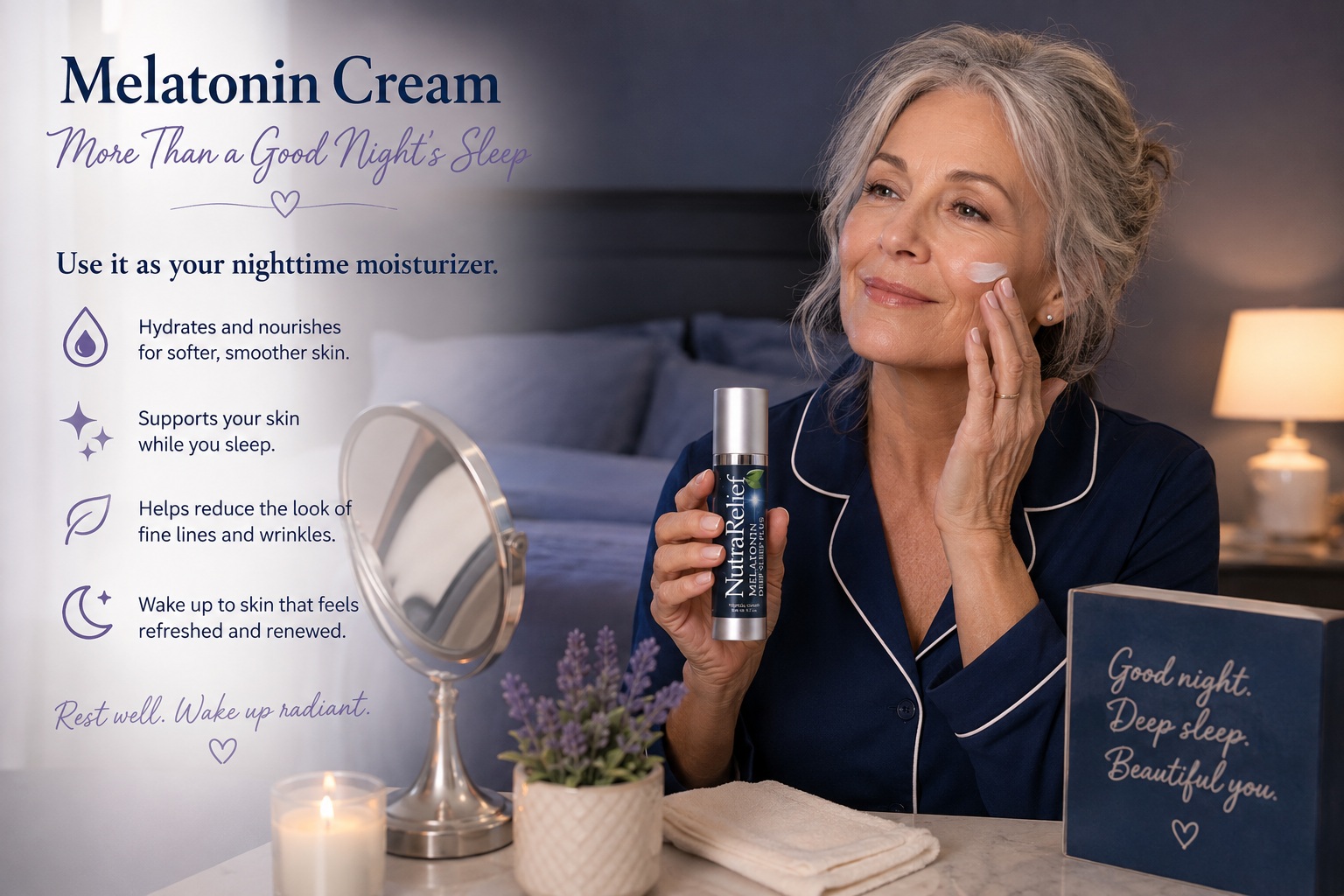
I started this 14-day journal because I wanted to see what would happen if I paid closer attention to my nighttime routine while using melatonin cream.
During a Wellness Wednesday webinar presented by Fun Savers Network, Dr. Daniel Lyons, creator of Nutra Relief Creams, hosted a question-and-answer session. I was the first one with my hand up.
I have lived with sleep apnea and insomnia for years, and I use a CPAP machine every night. I had already tried the melatonin cream for a couple of nights, but I wasn’t sure it was doing anything for me. I wanted to know more about how to use it and what I should realistically expect.
Man, did Dr. Lyons give me something to think about!
Instead of trying to remember whether I slept well or poorly, I decided to keep a daily journal for 14 days.
A note before you read: This is my personal experience, not medical advice. Sleep problems can have many causes, and anyone with persistent sleep difficulties should discuss them with a qualified healthcare professional.

Day 1 — August 12, 2026
My nights usually begin somewhere between midnight and 1 a.m. My husband, Charles, is my alarm clock, and he wakes me around 9:30 a.m. If I sleep through that entire period, I can get the seven to eight hours of sleep I want.
Unfortunately, it doesn’t always work that way.
I use my CPAP every night. Because I tend to breathe through my mouth, I use lip balm before bed and keep a small bottle of water beside me for those middle-of-the-night wake-up calls.
For this first day, I wanted to establish where I was starting.
Day 2 — August 13, 2026
Last night—or rather, at 2:20 a.m.—I finally closed the book I was reading and reached for the melatonin cream. I put one pump on my forehead and another on the lower part of my face, then massaged it in for about 30 seconds.
Let me just say that Nutra Relief Melatonin Cream was one of the creamiest, coolest, most calming “moisturizers” I had ever put on my face.
I proceeded to thank the Good Lord for letting me Live the Good Life and went to bed.
I was initially disappointed that I didn’t fall asleep immediately. Then something dawned on me: I was comfortable. I was lying on my left side as usual. My thoughts weren’t racing. My legs were still. I wasn’t thinking about everything I needed to do the next day. I was relaxed.
The CPAP was humming along, and the next thing I knew, it was 7:30 a.m. The first thing I noticed when I woke was that my mouth was closed. No dry mouth, and my head wasn’t stopped up.
And that, my friend, was a very nice way to start the day.
Day 3 — August 14, 2026
I used the melatonin cream the same way as the night before.
I went to bed at 12:40 a.m., although it still took me a while to fall asleep. I woke once around 3:30 a.m. Everything seemed fine—no dry mouth and no discomfort—and I went right back to sleep. The next time I woke, it was 8:15 a.m., and I was wide awake.
This time I noticed a little dryness in my mouth, and my CPAP nose pillows were off-kilter. Since it was nearly time to get up anyway, I removed the nose pillows, took a sip of water, and just lay there.
I wanted to see whether my nose would become stuffy without them. Instead, time crawled by while my brain kept saying, “It’s time to get up!” At 9:15 a.m., I finally did. I felt great.
Day 4 — August 15, 2026
I woke to a blinking clock, so I had no idea what time it was. It was daylight, though, and I was wide awake. Since I clearly wasn’t going back to sleep, I reached for my watch. 9:15 a.m.
Surprise! It really was time to start the day, and I was ready to go.
I hadn’t gone to bed until 2 a.m. because I was reading a good book and couldn’t find a place to stop. I don’t remember waking during the night. My mouth was closed, my nose pillows were a little wonky but still working, and I was breathing fine.
All in all, it felt like a good night’s sleep.
Day 5 — August 16, 2026
I changed the nose pillows on my ResMed 10 last night. It was NOT a good night for sleeping. The new nose pillow was too rigid to be comfortable. I finally got everything situated and went to sleep, but when I changed positions, the nose pillows didn’t cooperate. That woke me up.
My mouth was dry, so I took a sip of water. I did notice one positive thing: my nose wasn’t stopped up. I was considering removing the nose pillows altogether when I drifted back to sleep.
Charles woke me at my usual 9:30 a.m.
Day 6 — August 17, 2026
The nose pillows behaved themselves tonight. It took me a while to fall asleep, but once I did, I slept great. I even remember dreaming, which I don’t usually do. I didn’t notice any dry mouth or stuffy head.
I’ll take that as a good night.
Day 7 — August 18, 2026
Since I still wasn’t falling asleep quickly, I decided to turn my back to the clock so I wouldn’t be tempted to keep looking at it. I think it helped. I don’t know how long it took me to fall asleep because I was simply lying there, comfy and cozy. The next thing I knew, I was awake.
I had gone to bed at 12:40 a.m. It was now 3:50 a.m. I tried to go back to sleep, but alas, it was not to be. At 4:15 a.m., I got up and went to work at my computer. I felt good and clearheaded, so I finished a project around 6:15 a.m.
With nothing else pressing to do, I went back to bed—and went right back to sleep. This time I woke around 10 a.m. My sleep had certainly been interrupted, but the sleep I did get felt restful.
During the day: As the day wore on, I began to feel groggy and developed a mild headache. I took a nap for about two hours around 1 p.m. Afterward, I felt fine.
That was an important addition to my journal. How I felt during the following day mattered just as much as what happened during the night.
Day 8 — August 19, 2026
Last night I went to bed at 2 a.m. I have got to stop reading so long at night. Maybe I’ll start buying boring books!
I woke at 6:30 a.m. but wasn’t ready to get up, so I went back to sleep. When I woke again at 9:30 a.m., I was lying on my back with a dry mouth. That surprised me because I am normally a left-side sleeper. A sip of water, and all was well.
During the day: I felt fine until around noon. It was lunchtime, but I wasn’t hungry and was feeling sluggish. Once again, I gave in and took a two-hour nap. Afterward, I felt fine.
This made me wonder why I suddenly seemed to need naps to feel good. I hadn’t been regularly taking naps before this.
Day 9 — August 20, 2026
Last night I tried something different. I set a timer for one hour of reading. When the timer went off, I finished the chapter and closed the book.
Progress!
My head hit the pillow around 12:45 a.m. At 4:40 a.m., I woke fighting with the CPAP hose. That in itself wasn’t unusual. I checked the headset and adjusted the nose pillows, which felt as though they were being pushed up my nose.
Nothing helped.
Finally, I pulled the whole contraption off and realized my nose had become congested and I was having trouble breathing through it. That was unusual for me because my CPAP normally helps keep my nose clear.
Without the nose pillows, my nose gradually began opening again. I switched to a fuller pillow that elevated my head and went back to sleep. I woke again around 6:30 a.m. feeling congested. I dealt with that, but I couldn’t get back to sleep.
Eventually, I lay down on the sofa and slept for about an hour.
During the day: Surprisingly, I was fine. I didn’t need another nap and functioned well.
Day 10 — August 21, 2026
I remembered that Dr. Lyons had discussed adjusting the amount of melatonin cream being used, so I followed the instructions I had been given and used an additional pump on my forehead.
I went to bed around 2:30 a.m. Yes, I had finished another book.
I woke at 4:40 and again at 6:30 with a dry mouth. Each time, I sipped some water and went right back to sleep. Charles woke me at 9:30 a.m.
I also used the fuller pillow again.
During the day: I felt fine, didn’t need a nap, and functioned well.
Day 11 — August 22, 2026
Another good night. I followed the same routine as the night before. I went to bed around 12:30 a.m. and woke once around 4 a.m. because I was fiddling with the nose pillows.
As soon as I got them comfortable again, I went back to sleep and stayed asleep until Charles woke me.
During the day: This was not a good day, but it had nothing to do with sleep. I wasn’t feeling well, so I slept much of the day.
I suspected all that daytime sleeping might come back to haunt me at bedtime.
Day 12 — August 23, 2026
I was right. I wasn’t sleepy at bedtime.
So naturally, I did one of the worst things I could do when trying to become sleepy: I played Sudoku on the computer. I quit around 2 a.m. and still had my normal bedtime routine ahead of me—flossing, brushing my teeth, washing my face, and using the melatonin cream.
Then I wanted to read to relax. This time, however, I allotted myself one hour, and I stuck to it.
I got into bed around 3:30 a.m. thinking, “I have six hours until Charles wakes me.” I can’t explain it, but I slept those six hours. When Charles woke me at 9:30 a.m., I felt ready to get up.
During the day: My mouth was dry when I woke, although I didn’t notice whether it had been open. I was lying on my back, so I wasn’t particularly surprised.
I still felt sluggish and spent some time lying on the couch.
Day 13 — August 24, 2026
Dry mouth again, but this time I had been sleeping on my side. I began to suspect that this wasn’t simply about my sleeping position.
I checked my CPAP and noticed the water reservoir wasn’t using water as it normally should. That needed attention, so I made an appointment to have it checked.
Otherwise, I slept reasonably well. I woke around 6:15 a.m. feeling achy. I took a sip of water and went right back to sleep. I woke again around 8 a.m., took another sip of water, and briefly considered getting up. The next thing I knew, Charles was waking me.
After drinking water and getting up, the aches went away.
During the day: Monday was a good day. I felt good and was able to work with a clear head.
Day 14 — August 25, 2026
Fourteen days!
I slept well last night and woke only once for a sip of water. My usual nighttime routine worked well, and I got about seven hours of sleep.
During the day: The day went well. I had energy, my mood was good, and I made it through the day feeling fine.
That evening, I was going back to Dr. Lyons with my journal. I couldn’t wait to hear what he had to say.
What I Learned After 14 Days
The most interesting part of this experiment came after the journal was finished. During the August 26 Wellness Wednesday webinar, Dr. Lyons and I talked about what I had recorded.
One thing jumped out.
My reading.
Not necessarily reading itself—but the bright light over my left shoulder while I was reading.
I already knew that light at night could interfere with the body’s natural melatonin cycle. Somehow, I had never connected that fact with my own bedtime ritual.
Reading is something I love. To me, reading meant relaxing before bed. But there I was, trying to prepare myself for sleep while sitting under a bright light and sometimes reading until 1, 2, or even 3 in the morning.
The answer wasn’t necessarily, “Irene, you can never read at bedtime again.”
Instead, Dr. Lyons suggested several possibilities I could experiment with:
- Use a lower-wattage light.
- Try a red or warmer light in the evening.
- Stop reading about 15 to 30 minutes before going to bed.
- Use those last quiet minutes for prayer, meditation, or simply sitting quietly and allowing my mind and body to settle down.
That gave me something much more valuable than a simple yes-or-no answer about melatonin cream.
It made me look at my whole bedtime routine.
The Biggest Lesson Wasn’t in the Tube
I started this journal because I wanted to know whether melatonin cream would help me sleep. Fourteen days later, I realized I had been observing much more than a cream.
I was watching my reading habits, bedtime, CPAP comfort, sleeping position, dry mouth, congestion, daytime energy, naps, computer use, light exposure—and even my tendency to stay up because I simply wasn’t ready to put down a good book.
That’s probably the biggest lesson I took from this experiment. Sometimes we focus on the one thing we hope will solve a problem and overlook all the little things surrounding it. Keeping a journal forced me to notice those little things. And now I have another experiment to try.
What would you do if reading were part of your bedtime ritual?
Would you switch to a softer or red light? Would you stop reading 15 or 30 minutes before bed and use that time to pray, meditate, or simply be quiet?
Or would giving up those last few pages of a good book be as hard for you as it is for me?
I’d love to hear what you would try.
As for me, I’m not giving up my books. I’m just going to learn how to make reading—and the quiet time that follows—a better part of my bedtime routine.
More Than a Sleep Aid—A Little Beauty Benefit, Too